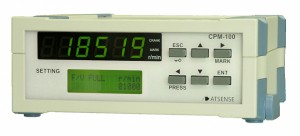
The CPM-100A converts crankshaft position sensor signals into encoder-equivalent output signals.
It provides high-resolution outputs of 720, 360, or 180 pulses per revolution.
It can be used to generate crank angle signals for combustion, vibration, and noise analysis.
■ Output pulse cycles are corrected depending on fluctuations in the rotational speed
■ There are no output pulse errors
For every low-resolution pulse entered, the pulse multiplication method generally outputs the same number of pulses over a constant period as the multiplying ratio.
This method accumulates errors in the number of pulses output because the input and output phase are not synchronized with each other, producing a deviation in the angle.
On the other hand, since CPM-100A corrects the output pulse cycle depending on fluctuations in the rotational speed, the deviation in the angle does not occur.
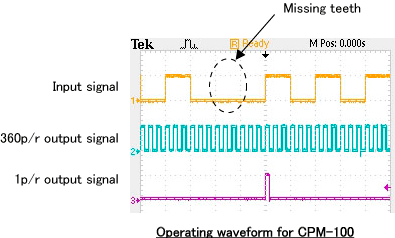
There are teeth missing in order to provide an angle reference for the crank position sensor.
As shown in the actual operating waveform in the figure below, CPM-100A continuously outputs a 360p/r signal even if there are missing teeth, and simultaneously outputs a 1p/r signal.
Supported Signal Plates
■ One missing-tooth position / No missing teeth
Number of base teeth: 1, 4, 6, 8, 12, 15, 18, 20, 24, 36, 40, 60, 120
Number of missing teeth: 0, 1, 2, 3, 4
■ One additional tooth position
Number of base teeth: 4, 6, 8, 12
Additional tooth position: 1/3, 1/2, 2/3, 1/4, 3/4 of the base tooth pitch
■ Two missing-tooth positions
Number of base teeth: 36, 60, 120
Number of missing teeth: 2, 3, 4
■ Three missing-tooth positions
Number of base teeth: 36, 60, 120
Number of missing teeth: 3, 4, 6, 9
*Signal plates with two or three missing-tooth positions are limited to specific patterns.
*Please contact us for other specifications.
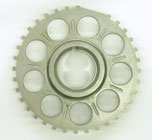
Number of base teeth: 36
Number of missing-tooth positions: 1
Number of missing teeth: 2
| Display | |
|---|---|
| Displayed item: Display method | Rotational speed display: 6 digits × 1 line, character height approx. 14.2mm, 7-segment LED, green |
| Settings display: 16 characters × 2 lines, character height approx. 5.6mm, character LCD, green backlight | |
| Crank / Mark signal input | |
| Connector | BNC receptacle and screwless terminal block |
| Input frequency | 10 to 20,000Hz |
| Input signal | Sine wave (trigger level 0V) / square wave (trigger level +2.5V) |
| Trigger slope | Rising / Falling |
| LPF | OFF / 20kHz (-3dB) |
| Pull-up | OFF / ON (terminal block only) |
| Sensor power supply | +12V (40mA) |
| Input resistance | 100kΩ |
| Input voltage | ±50V (maximum rating ±100V) |
| Wave shaping output voltage | 0-5V |
| Corresponding signal plates | ■ One missing-tooth position / No missing teeth Number of base teeth: 1, 4, 6, 8, 12, 15, 18, 20, 24, 36, 40, 60, 120 Number of missing teeth: 0, 1, 2, 3, 4 ■ One additional tooth position ■ Two missing-tooth positions ■ Three missing-tooth positions * Signal plates with two or three missing-tooth positions are limited to specific patterns. |
| Multiplied pulse output | |
| Number of outputs | 2 outputs (BNC receptacles) |
| Output items | ANGLE output: 180 / 360 / 720P/R, TDC output: 1P/R |
| Output voltage | 0-5V |
| Output logic | Positive logic / Negative logic |
| F/V output | |
| Number of outputs | 1 output (BNC receptacle) |
| Output voltage | 0 to 10V |
| Update time | 1ms |
| Moving average | 1 to 499 |
| Arithmetic | |
| Time resolution | 40MHz |
| Memory setting | EEPROM |
| General specification | |
| Input power supply voltage (power) | DC9 to 32V (10W) |
| Insulation | DC power supply / crank signal input / mark signal input / F/V output / ANGLE output, TDC output and wave shaping output |
| External dimensions | W: 184 × D: 196 × H: 70mm (excluding projecting parts) |
| Weight | Approx. 810g |
| Operating temperature and humidity range | 0 to 40°C / 85%RH or less (with no condensation) |
| Accessories | AC adapter, DC plug cable |
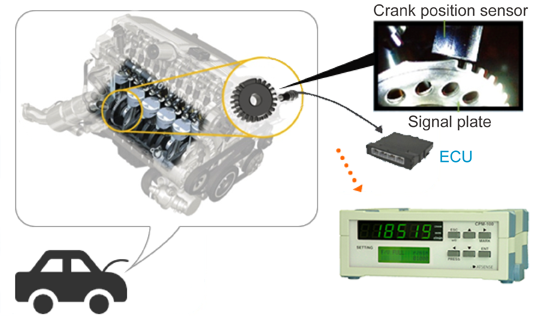
Multiplication of plate/crank position sensor
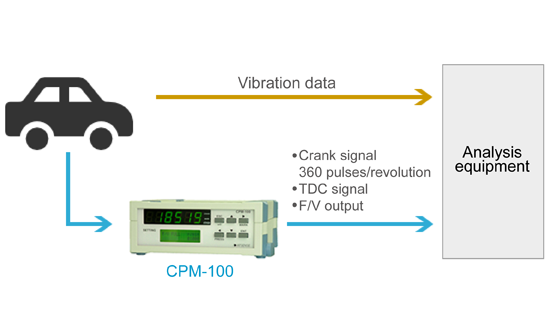
Flexible application for other than combustion analyses
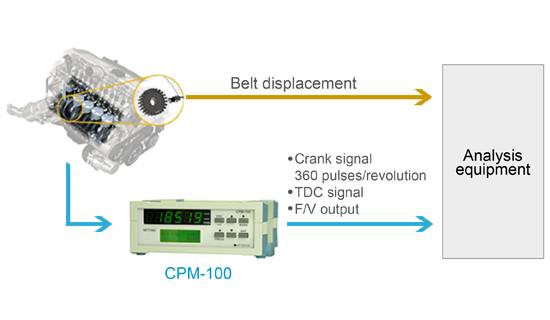
No rotary encoder needed for the engine.

